




June 2, 2026
Approaching the Solar Apex
Share
Week of June 7-13, 2026
During one of my recent night sky tours, an elderly guest gazed into the sky and asked if the stars ever move. He said the constellations look the same now as when he was a child, and he was convinced that nothing in the heavens ever changes.
It was an excellent observation but one that didn't consider an important fact: Human time scales are considerably different than cosmic time scales.
Even the healthiest of humans will live at most about a century, and during our lives, we measure time in seconds, minutes, hours, days, weeks, months, years and decades. The cosmos, on the other hand, has been around for nearly 14 billion years, and everything takes much longer to occur.
To recognize changes in the universe, astronomers must think on a more cosmic scale. When we do, we find that the universe is remarkably active. Stars are forming, consuming their nuclear fuel, and dying, and all are racing through our galaxy at tremendous speeds. Expecting to see changes in any star's appearance or the shapes of constellations over even a full human lifespan just isn't possible.
To understand this, consider Barnard's Star, visible only through a telescope from the Earth's Southern Hemisphere. This star tears through our galaxy at a speed of some 88 miles per second, yet from our terrestrial vantage point six lightyears away, Barnard's Star requires three and a half centuries to cross a segment of the sky only the width of your outstretched little finger.
Of course, we can't watch this movement with our eyes — or even through powerful telescopes — but by using sophisticated earthbound and satellite technology, astronomers can precisely measure these stellar speeds and directions of motion.
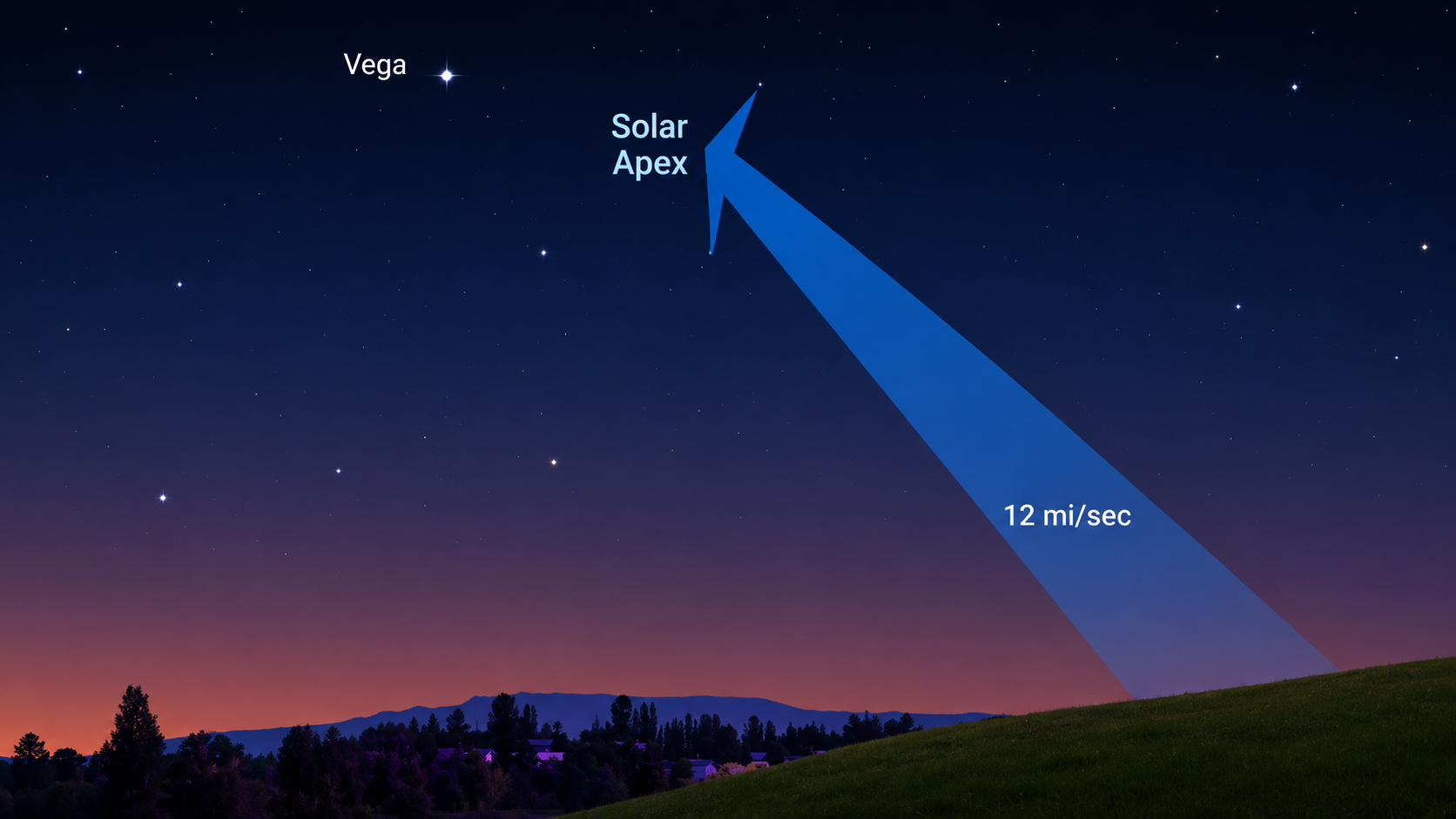
Measure the speeds and directions of enough stars, and we find some interesting patterns. For example, stars that appear roughly in the direction of the summer star Vega (now shining low in the northeastern sky after dark) seem to be spreading out from a central point, while those on the opposite side of the sky (near Sirius, setting in the southwest around sunset) appear to be converging on one another.
What this means is fascinating. Our sun's own motion is carrying it (along with the planets of our solar system) toward the stars near Vega — a point we know as the solar apex — and away from those near Sirius (known as the solar antapex).
This phenomenon isn't difficult to visualize. Imagine you're driving along a highway from one city to another. The buildings in front of you appear to become more widely separated as you approach, while those behind you appear to converge more tightly.
This is exactly what's happening in our section of the galaxy. Our sun is moving at some 12 miles per second toward a point in our sky not far from the bright star Vega. Of course, we can't see this movement, but it's fun to stand outdoors on a clear night and imagine our sun and Earth racing outward toward Vega.
Now, if you're worried about a collision with this star ... well, fuhgetaboutit. Even at this remarkable speed, we'd need some 5,300 human lifetimes to get there!
Visit Dennis Mammana at dennismammana.com. To read features by other Creators Syndicate writers and cartoonists, visit the Creators Syndicate website at www.creators.com.
Learn More About Borrego Springs